A question I get a lot is “What do you do on days you’re not diving?”. This is a completely reasonable question – we spend eight weeks here, but hope to get between ten and fifteen dives. We’ve already covered what happens in the first week – a lot of unpacking, inventorying, and setup – and can reasonably assume that the last week is the reverse of that – packing, inventorying, and shipping. That leaves four weeks of days unaccounted for – what do we do with all that time?
Water sampling, CTD casts, and sample processing
While maybe unfair to lump these all together, often non-dive days provide an excellent opportunity to do science with a lower logistical load. Water sampling and CTD casts can be done by a smaller team and require less setup and time than Icefin, and can be collected from different sites than the Icefin dive sites.
After the samples are collected, the samples for microbial and metal analysis need to be processed before they return to the US, so non-dive days can also be used to do this processing.
Veronica Hegelein (left) and Dr. Brandi Revels (right) extracting sampled water from the Niskin water sampler.
Dr. Brandi Revels (left) and Veronica Hegelein proudly displaying the first processed sample of the season
A Niskin water sampler emerging from the borehole as deployed over Icefin's A-frame
Moving sites
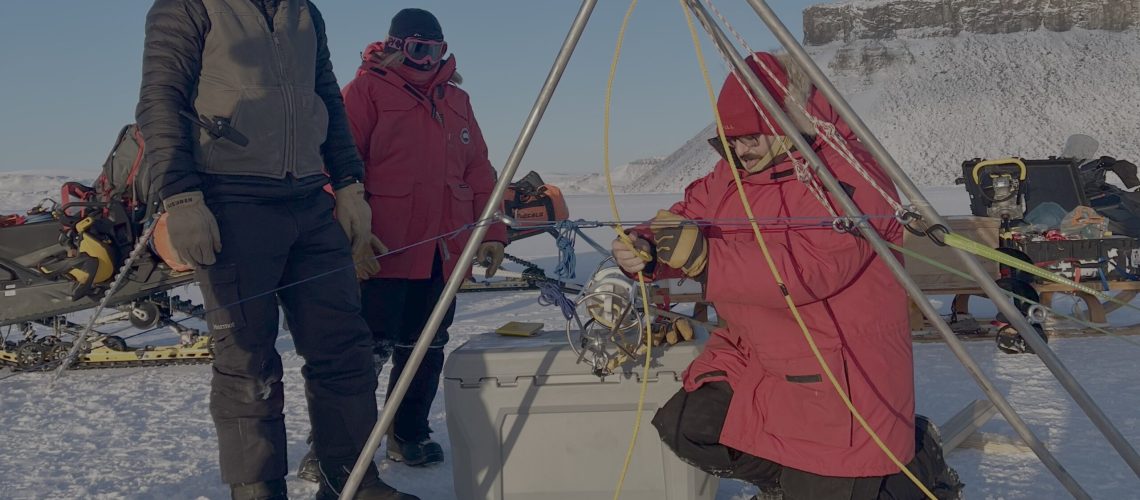
Icefin's Launch and Recovery System (LARS) broken down and packed on a sled to tow to the next site.
To go from one site to another, we need to break down the deployment A-frame (Launch And Recovery System, or LARS), drag all our gear to the new site, and set it all back up again. While it is possible to break down the entire camp after a dive, non-dive days are a much less stressful time to complete this work.
The team preparing the various equipment, including two fiber optic winches, to go from base to a field site.
Fixing broken things
Things break. We fix them.
Sometimes this is something in Icefin itself – a bracket needs to be replaced, or the electronics need to come out of their pressure vessel and be troubleshot. This often takes at least a day – after “unbottling” the pressure vessel, identifying the issue (if there is only one), and fixing it, we then must re-run all our functional tests, a vacuum test post re-bottling to make sure the pressure vessel won’t leak underwater.
Sometimes this is a repair to field equipment, like patching a hole in a tent or a sled, or fixing a generator. The team comprises a broad skillset, so there’s almost always someone who can tackle a problem and do a repair.
Daniel Lein, adding a new cable to Icefin's electronics to enable a new instrument.
Investigating data and planning dives
The first thing the scientists do after coming back from a CTD cast is race to get the data from the instrument to their computer to see what the instrument saw. This first look, however, needs further processing and interpretation; scripts need to be run and plots need to be plotted. These interpretations are not only just fun for the science nerds, but also critical to inform future dives, both their locations and operations.
On non-dive days, the science leads can take their time to go through the data and meet to plan the next dive. Then, the whole group gets together to discuss the dive plan so everyone knows what to expect from the next day out, both the vehicle operation and individual jobs.
Rest
Polar fieldwork is physically exhausting – we are constantly burning energy just to stay warm while also lifting and moving heavy equipment (Icefin itself, water samplers full of water, Pelican boxes full of tools and gear), and doing all that for an extremely long day. Rest days are exceedingly important to maintain physical and mental health over eight weeks of work, so days directly following a dive start later, and every week includes at least a half day fully off-the-clock.
In addition to sleeping, resting (without too much access to internet) comprises reading (and talking about) books, watching movies that play on the base’s TV stations, playing board games with each other, or battling the cold with some heat from the sauna.
Veronica Hegelein has proven to be the team member who is most likely to fall asleep at a given moment, demonstrates her skill here for finding rest in any second of downtime