This is the second year of our project supported by NASA (PI Schmidt, Co-Is Washam, Meister, Bryson, Lein & Girguis) called SSHOWUP: Sample Selection and Handling for Ocean worlds and Wolstenholme fjord Under-ice Platforms. This project is a 4-year grant to accomplish three field campaigns in Greenland. The SSHOWUP Project was developed to simulate and advance elements of a future Europa mission while studying similar environments on Earth. We are using the underwater vehicle Icefin as a platform to conduct missions under the sea ice and glaciers of Wolstenholme Fjord both as an analog for Europa and to advance our understanding of conditions and life under the ice, while learning a lot more about the glaciers on our home planet along the way.
Overall, our goals this season are to:
Map oceanographic conditions and search for freshwater plumes under the sea ice, mélange, and glaciers by conducting surveys with oceanographic sensors and investigate the dynamic response of the ice to the ocean by mapping ice structure and ocean conditions as they change.
Measure the nutrient sources, volatile gases, and microbial populations in the under-ice ecosystem.
Phil Norris, Polar Bear Guard (swapping with Paul mid March)
Justin Lawrence, Science (joining mid March)
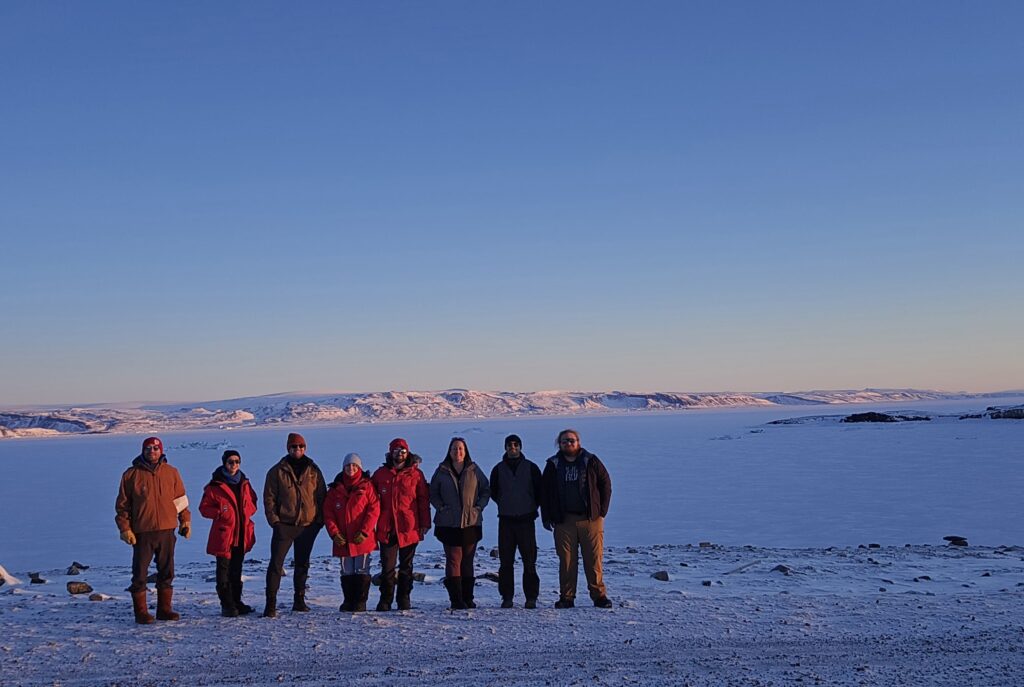
The 2025 field team in front of Wolstenholme Fjord - mostly the same people, with few substitutions. This year's team photo will be waiting for the success of our first dive.
The Science
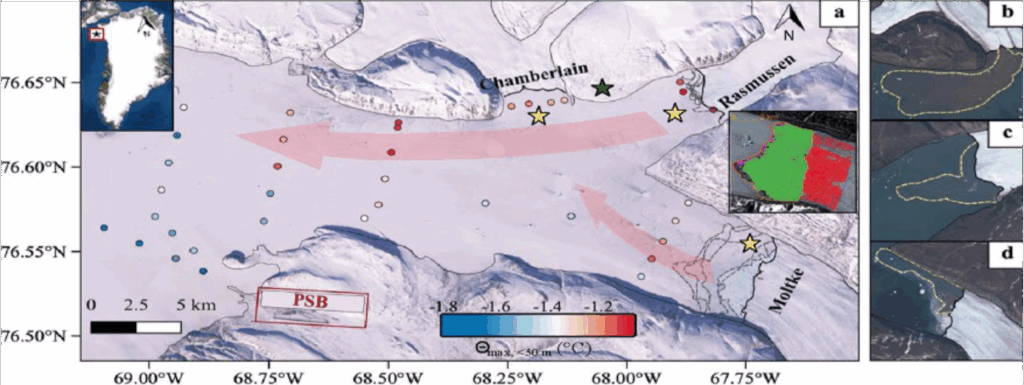
We are working from Feb 21st-April 17th, 2026 in Wolstenholme Fjord. Wolstenholme Fjord is home to three marine-terminating tidewater glaciers: Chamberlin, Moltke, and Rasmussen. Sea ice pervades the Fjord from October to June and a region of mélange (broken up bits of sea ice, bergy bits, and icebergs) exists in front of Moltke glacier which is frozen in each year as the sea ice reforms. Turbid, sediment-laden surface waters in front of the glaciers reveal the presence of subglacial meltwater discharging from subglacial rivers beneath the glaciers that are most active in the summer but also active in the wintertime. This water likely provides both heat, which when exported to the upper ocean likely increases melting of the glacier fronts, sea ice, icebergs, and mélange, and also nutrients which may sustain and fertilize subglacial and coastal ecosystems. The glaciers in the Fjord have receded significantly, with Moltke receding now at a rate over 1km per year, mirroring the expected increase in glacial melting and subsequent sea level rise globally. Hence Wolstenholme Fjord provides a natural laboratory to study the complex interactions between ice, ocean, and atmosphere during Greenland’s winter and as a proxy for glacial change in both polar regions. Furthermore, its proximity to Pituffik Space Base considerably reduces some of the complexity with campaigns in the Arctic.
A map of Wolstenholme Fjord and with the three glaciers we will be investigating.
Water Sampling
One of the project goals this year is obtaining water samples for nutrient concentrations, dissolved organic carbon, microbes, and metal isotopes. These properties are crucial for understanding the ecosystem within the fjord and how it shifts seasonally from late winter to early spring. Comparing the microbial analysis within and outside of a subglacial discharge plume will help tell us about potential ecosystems beneath the glacier. This will be paired with iron isotope fragmentations, which can also help tell us what type of metabolisms are present beneath the glacier; different metabolisms preferentially use specific isotopes. The nutrient concentrations can tell us how much energy is available for microbial communities throughout the season, and also give us an idea of how much nutrients are being delivered to the fjord from beneath the glaciers.
By mapping the nutrient sources and investigating the wintertime ecosystem after several months of darkness, the fjord additionally becomes a relevant astrobiological analog for ocean worlds.
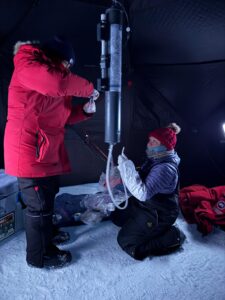
Veronica Hegelein (left) and Dr. Brandi Revels (right) extracting sampled water from a Niskin water sampler in the field.
The Technology
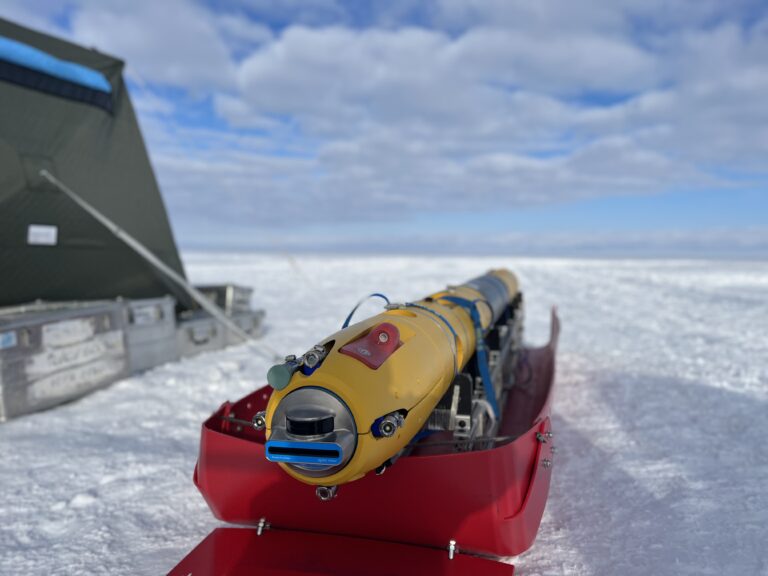
Icefin in a sled on the snow, preparing to be launched down a borehole.
A major goal of the SSHOW UP project is technology development to enable a future landed Europan mission. In this project, we simulate a future landed mission within the ice simulated by a through- ice base station that acts as a communication pathway for a mobile platform (Icefin) and enables both mobile and stationary sampling and monitoring measurements. This is the goal for the three-year project, but this season we’re putting a greater focus this year on instrument development, data processes, and improving vehicle autonomy.
Critical for planetary missions, in which communication is both delayed and minimal, is the ability for vehicles to autonomously make decisions based on their onboard sensors. To that end, we are developing sensor-based decision-making protocols to optimize science return, such as applying machine learning algorithms to Icefin’s science data to recognize signals such as the subglacial meltwater plumes.
Particularly important to astrobiology research, the team is building new underwater mass spectroscopy techniques that will be the first to be used in situ in this environment. Stay tuned for a special on SUIMS, the Submersible Underwater In-Situ Mass Spectrometer!