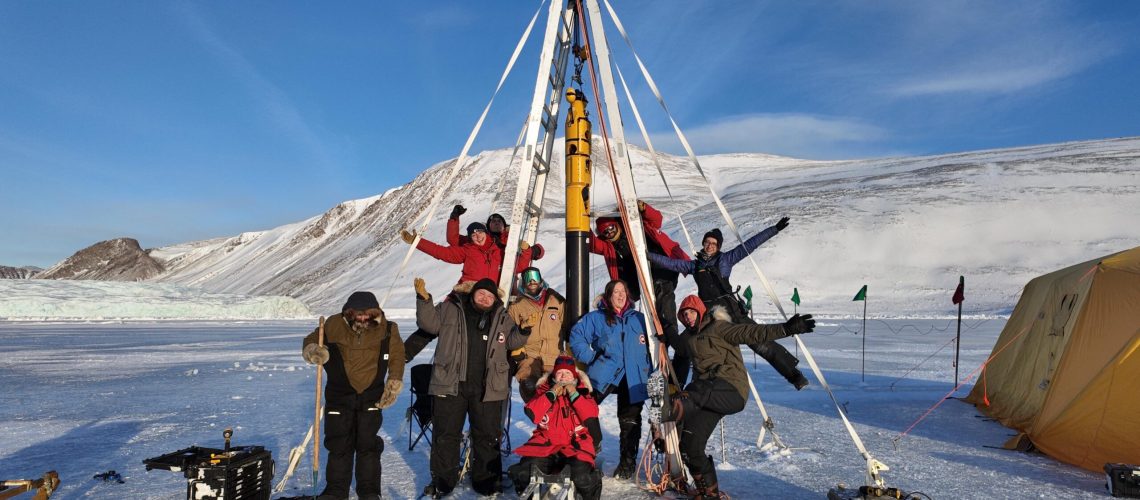
We’re in the middle of our season now, so let’s do a recap of what we’ve accomplished so far this year.
Water Sampling
A priority of this season was to collect water samples early in the season – this is so important because the whole environment has not yet shifted from the dark of the winter to fully sunlit, so the communities under the ice are potentially quite different as a function of light and temperature. The team was able to get out as early as March 2nd to take our first samples at the mid-fjord. These samples will be used to study microbial masses, metal isotopes, and noble gases, which we will use to “fingerprint” water masses-determining where the water has formed and with what it’s interacted. The most important questions we have are where the ocean water forms, and how much melt water – which can be sourced from the the melting of the base of the glacier by the ocean or from the melting from the sea ice – is contributing to the fjord. These samples are difficult to collect as it is imperative that they not freeze – which is not particularly difficult when it is –40 degrees out!
Since then, the team has collected samples at multiple depths – the surface, near seafloor, and subglacial plume – at both the mid-Fjord site as well as in front of Rasmussen glacier. Once the samples are collected, the science team’s work isn’t done, because the samples go back to the clean lab and need to be processed.
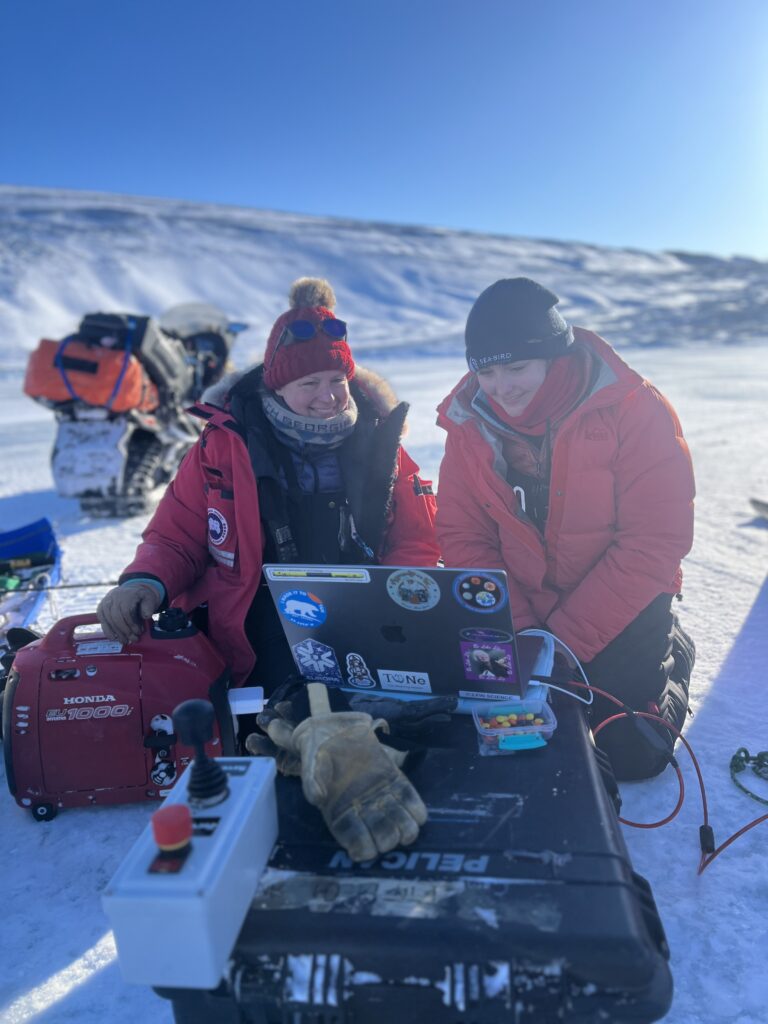
Dr. Brandi Revels and Veronica Hegelein analyze data from a CTD cast before deciding where in the water column to take water samples.
Instrument Deployments
SUIMS – As part of SSHOWUP’s ongoing technology development goals, we completed the first field deployment of the Submersible Under-Ice Mass Spectrometer (SUIMS). Following its initial proof-of-concept testing during the previous season, the instrument has undergone significant upgrades informed by those earlier results, with expanded science and engineering objectives. Key improves include the addition of an external battery module, which allows SUIMS to operate independently of surface power and removes a major limitation on deployment depth, as well as the integration of a fiber optic communication system to enable extended deployments. The system is also now equipped with integrated temperature and pH sensors allowing simultaneous measurement of environmental conditions alongside dissolved gas composition.
Early in the season, two deployment attempts at the WF1 site provided valuable system validation and operational experience. Lessons learned from these efforts informed adjustments that led to a successful deployment at the R1 (Rasmussen glacier) site. At R1, SUIMS was deployed through the Icefin dive hole, and operated alongside an RBR Concerto CTD to provide complementary conductivity, temperature, and depth (pressure) measurements. The instrument profiled the full water column, reaching a record depth of 50m; a substantial increase from the previous season’s 3m record. During the descent, SUIMS collected full spectral scans form 0 to 100AMU at 10m intervals, followed by targeted vertical profiling across a suspected plume layer while acquiring continuous time-series measurements of selected gases.
This successful deployment demonstrates SUIMS’ capability to perform in situ dissolved gas measurements beneath ice for the first time, representing a significant step forward in sub-ice observational capability and enabling new insights into water mass sources and biogeochemical processes in these environments.
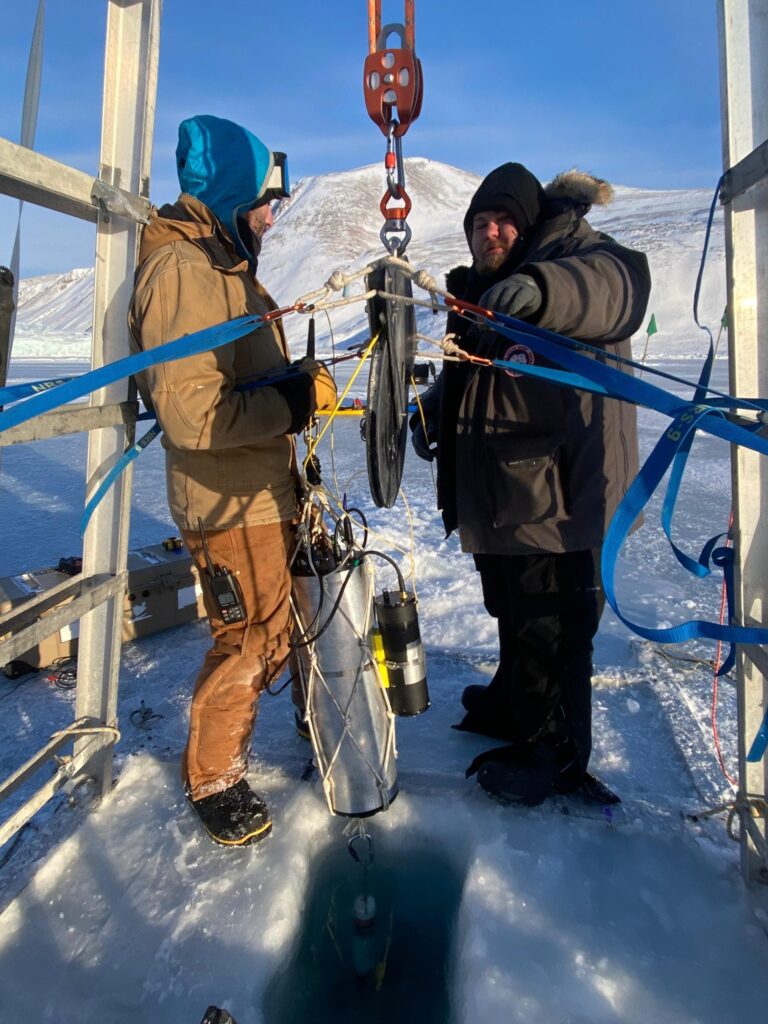
Dr. Justin Lawrence and Jorge Coppin-Massanet deploy SUIMS at the Icefin dive site by Rasmussen glacier
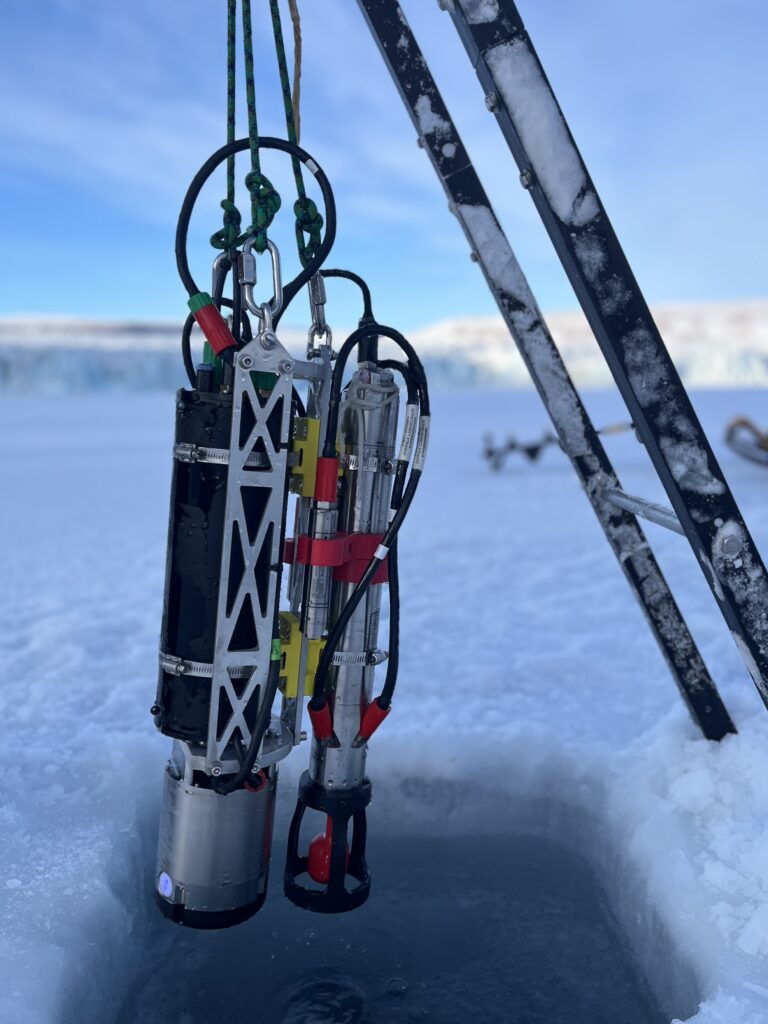
CLAWS returning from a cast in front of Chamberlin glacier.
CLAWS – The Co-Located ADCP and Water Sampling instrument is new this year; CLAWS was developed as a way to augment the measurements of a CTD cast and water sampling with one of our ADCP (Acoustic Doppler Current Profiling) instruments. The ADCP can measure the movement of particles in the water to collect information of the direction and speed the water column is moving up to 80m away; but needed some additional hardware and sensors to provide the heading and orientation context. Thus, CLAWS was born as a student project at Cornell. Undergraduate engineering students Parishee Bajaj and Eli Pate have been working the past two semesters on developing CLAWS, and we are excited to deploy it this year.
CLAWS co-locates our new CTD instrument (RBR Concerto 3), with the ADCP (Nortek DVL 500), and can be used alone or hanging beneath a Niskin water sampler.
Seismic array – The objective of this part of the SSHOWUP project is to observe the front of a glacier for several weeks with seismometers and to “listen” for calving events and movement in the sea ice due to tides. Using this data, we hope to better understand how sound waves move through different types of ice and what we can learn about the ice by examining how the waves change as they move from one point to another. The deployment of the sensors was the culmination of a several-week effort. First, we used satellite imagery data to determine the best locations for the seismometers. Then, we needed at least a half day with good weather and no other major science goals to go out and drill the holes. Moltke glacier is a long trip away from base, so finding the time to do this took a while. Lastly, after the holes were drilled, we needed to wait at least a day before installing the seismometers: these sensors require a very flat and level surface to work properly, which we achieve by pouring water into the bottom of their holes and waiting for it to freeze––gravity reliably makes a perfect, level surface! This past Thursday, with the holes prepared and ready, Daniel, Justin, Phil, and Mike made the trip out to Moltke and successfully deployed the seismometers.
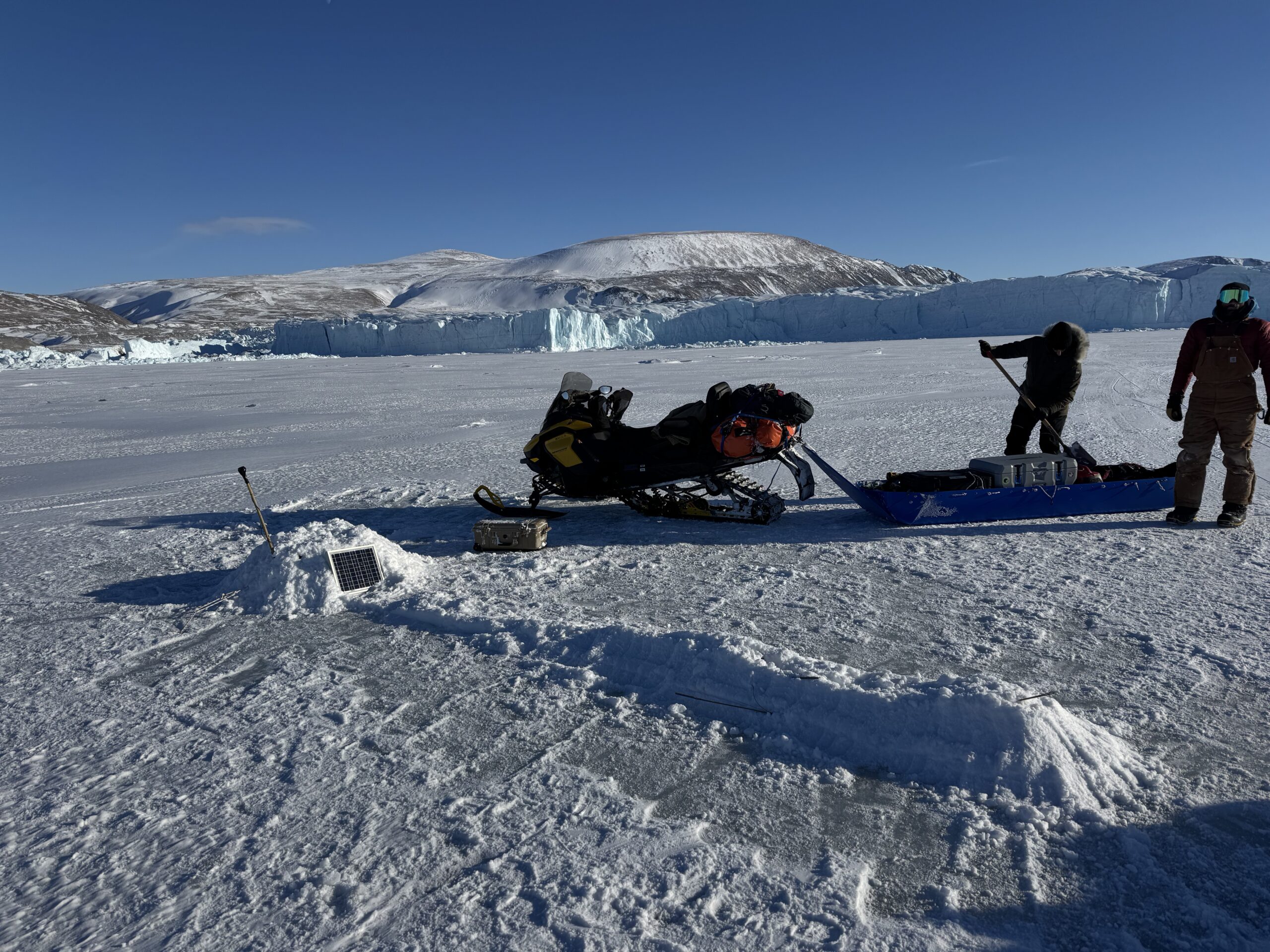
Phil Norris and Dr. Justin Lawrence pack up a sled following a successful deployment of a seismic sensor in front of Molte glacier. The seismic sensor itself is buried in a hole in the ice, while the datalogger and battery are in a box under snow to (hopefully) appear less interesting to wildlife.
Icefin Dives
Confounded by challenges but never deterred, Icefin has been deployed four times this season. The first dive was mid-fjord, with a goal of repeating some hydrology measurements from last year to compare between the two years – this means that Icefin spent several hours driving between the surface and the deep water (80-90m) in what is called a yo-yo maneuver (think of a sawtooth shape) to cover roughly 2km of the fjord’s entrance and collect data throughout the water column.
After that, we moved to Rasmussen glacier, excited to find the subglacial channel again. This took three attempts, and included some major challenges as we had to take a few days to repair one of our winches before heading back out to the ice. But, third time was a charm – sort of. The team, now all veterans of at least two other dives, worked together seamlessly, fixed equipment as challenges arose, and had an incredible day out on the ice. Icefin swam out to where we’d found the channel last year, where we found some combination of a crevasse and a channel – a “crevannel”, if you will. After twenty minutes of nailbiting maneuvering through the labyrinthine crevasse, we pulled the robot back to the face of the glacier, continued a sonar scan for other signs of channels, and brought Icefin back for a team picture.
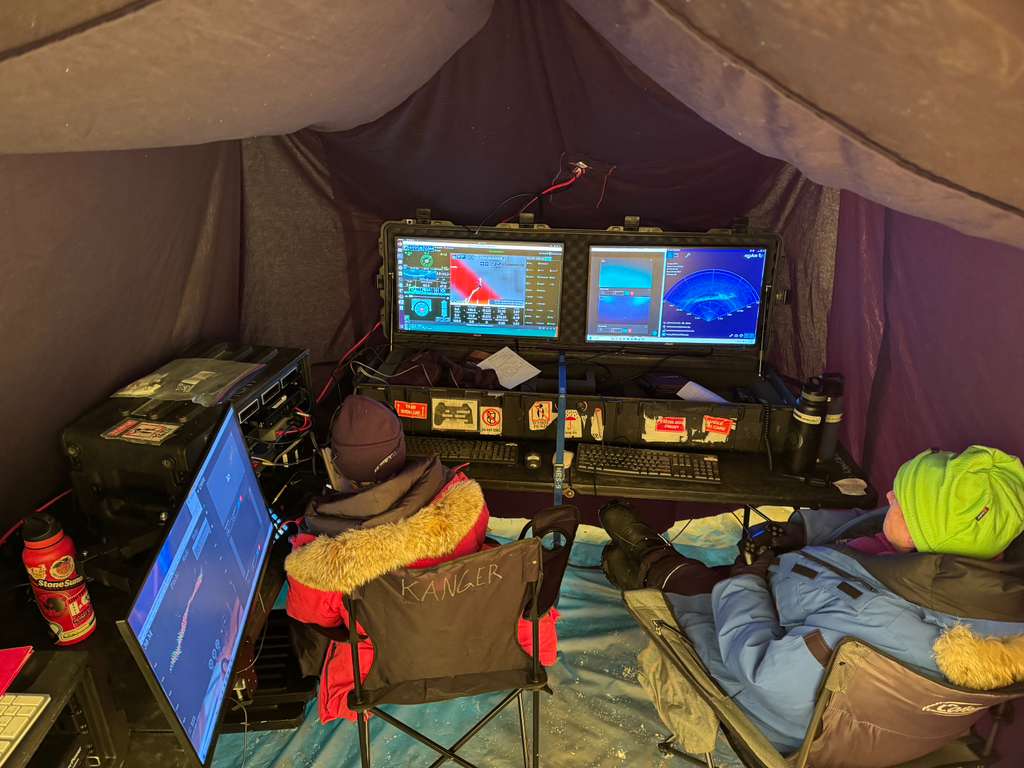
Dr. Frances Bryson and Dr. Britney Schmidt in front of the topside control station, driving the robot in front of the face of Rasmussen glacier, looking for the subglacial channel.
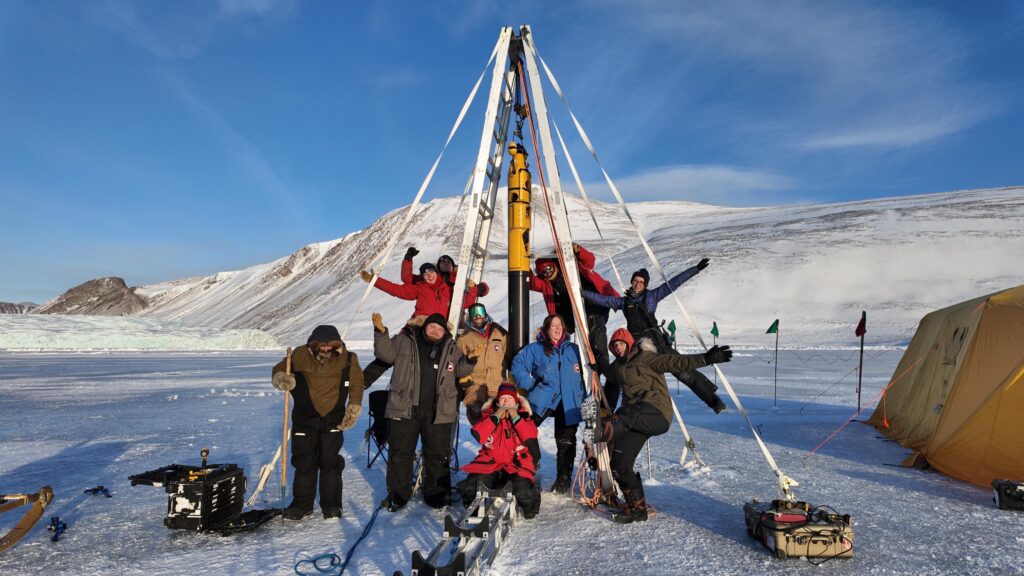
The team poses in front of Icefin at the dive site in front of Rasmussen glacier. From left to right: Phill Norris, Henry Wolf, Veronica Hegelein, Jorge Coppin-Massanet, Justin Lawrence, Brandi Revels, Britney Schmidt, Daniel Lein, Mike Toillion, Frances Bryson. Thanks to Mike Toillion for the photo!
Challenges
This year we faced many more challenges than anticipated, both new and well-known, that caused some delays and scope-reduction. Let’s go over what can go wrong in polar fieldwork:
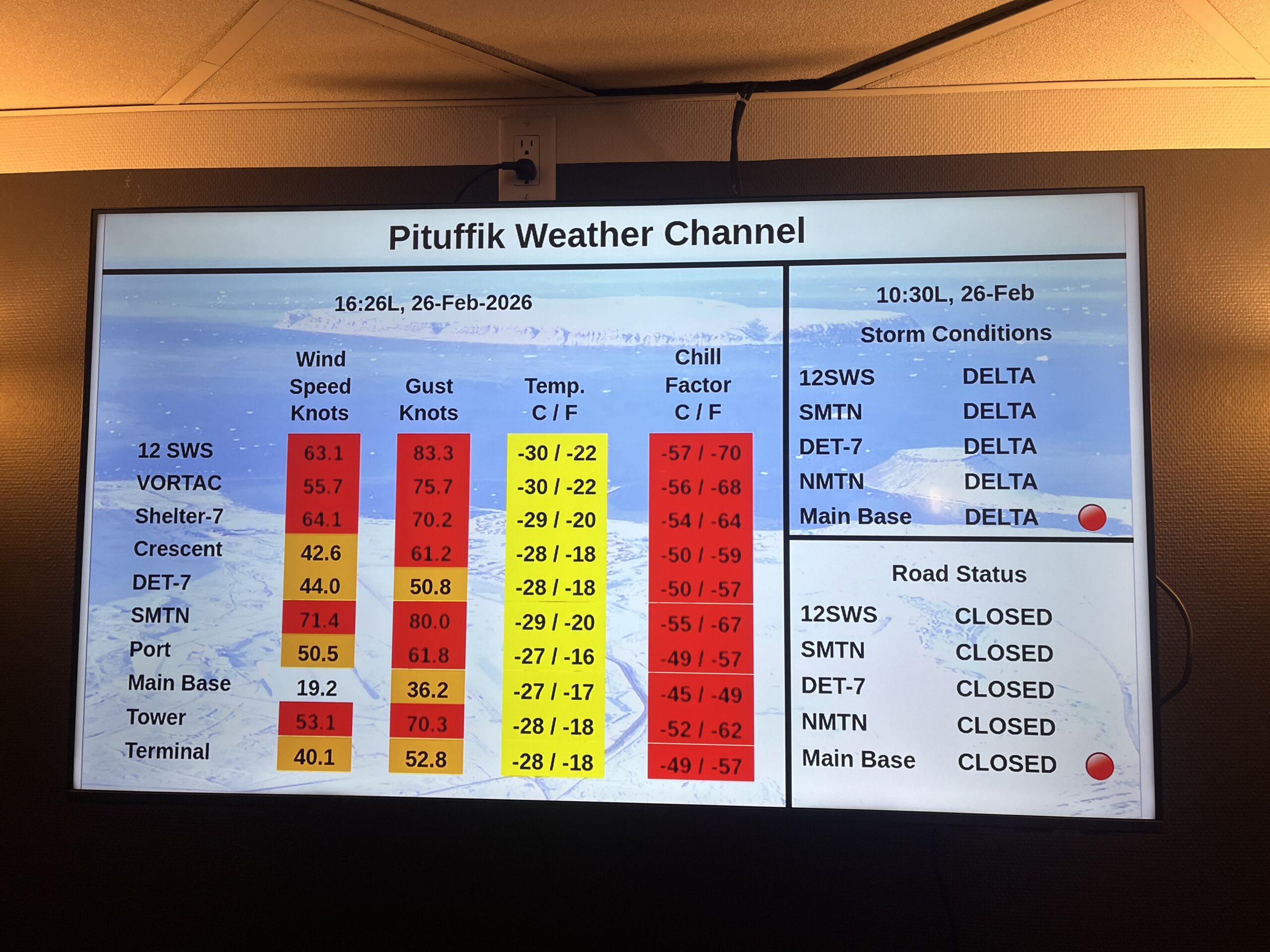
Weather – Weather delays are something every polar research team faces. This season we were immediately hit with a huge storm in early March that confined us to our dormitory for three days. Sustained winds were over 30 knots, with gusts up to 60 knots – there was no going outside for anyone. Beyond storms, low visibility makes sea ice travel dangerous, both for driving and spotting wildlife, and can be a reason to change a day’s plans.
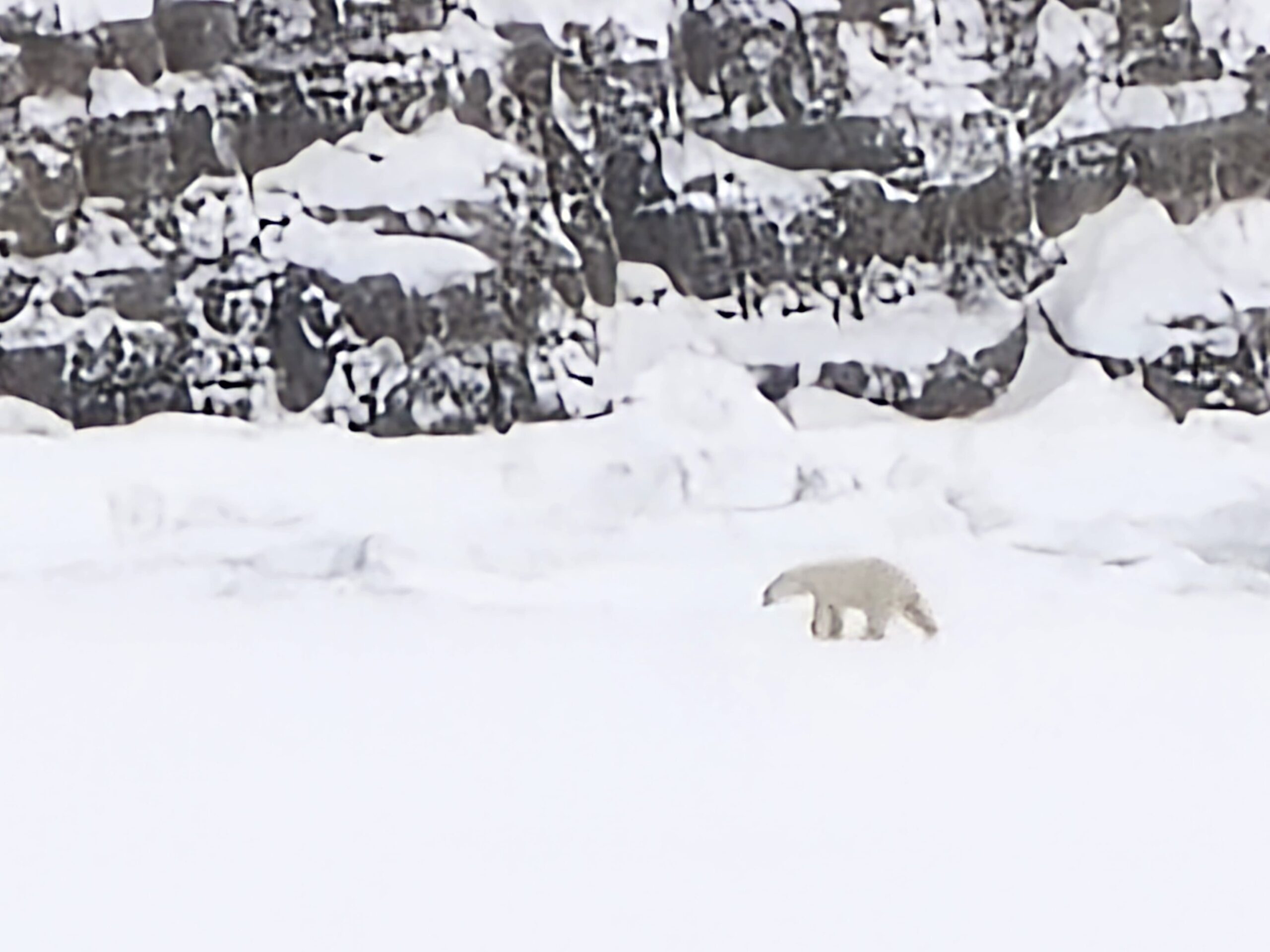
Wildlife – Here in the Arctic, we are intruding in an environment that belongs to polar bears, and the last thing we want to do is disturb them. We take every precaution against bears, and when one is spotted near a site sometimes the best decision is to turn around and work in a different area that day.
Equipment – This year we faced some pretty mission-critical equipment failures, but fortunately were able to find fixes to all of them. From communication issues both on the robot itself, to issues with the fiber optic winch itself, we have had to adapt and scrap missions to allow for time for repairs. Fortunately, our hard work paid off and we’ve found either fixes or workarounds to these challenges and are prepared to dive again.
Here at Pituffik, areas receive different "storm conditions" that denote what amount of travel is possible. Condition Delta means no one leaves their dorm, period.
Our first polar bear sighting - nearly a mile away and walking away from us. They're looking for seals, not humans, so by using our snowmachines to make noise and appear larger we make it clear we're not something they want to investigate.