We’re here in Greenland for eight weeks to gather incredibly valuable data; which, unsurprisingly, takes some hard work. We hope that in this time we can execute at least twelve dives with Icefin at various sites around Wolstenholme Fjord. These days are cold and grueling from both the physical exertion and constant focus required from the (abbreviated) dawn to well past dusk. Let’s walk through our schedule for a typical dive day.
0830 - Loading trucks and sleds
Dive days start relatively early – loading trucks with the equipment that stays in the dorm (Icefin itself, computers, personal bags, etc.) at 0800 means we’ve gotten up, eaten breakfast, prepared lunch, packed all our daily gear, and stepped into our ECW (extreme cold weather) clothing before then.
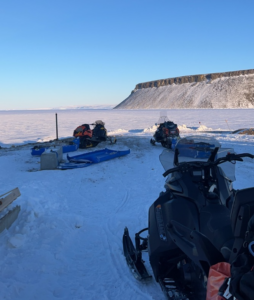
Trucks, laden with equipment, drive down to “the transition” – that is, the literal transition between land and sea ice. We keep our sleds and some cold-hardy equipment there, and load all the extra equipment into sleds, then strap it all down for the bumpy ride over ice tied to the back of a snowmachine.
Snowmachines at the sea ice transition, with sleds being loaded and connected.
0930 - Check out and commute
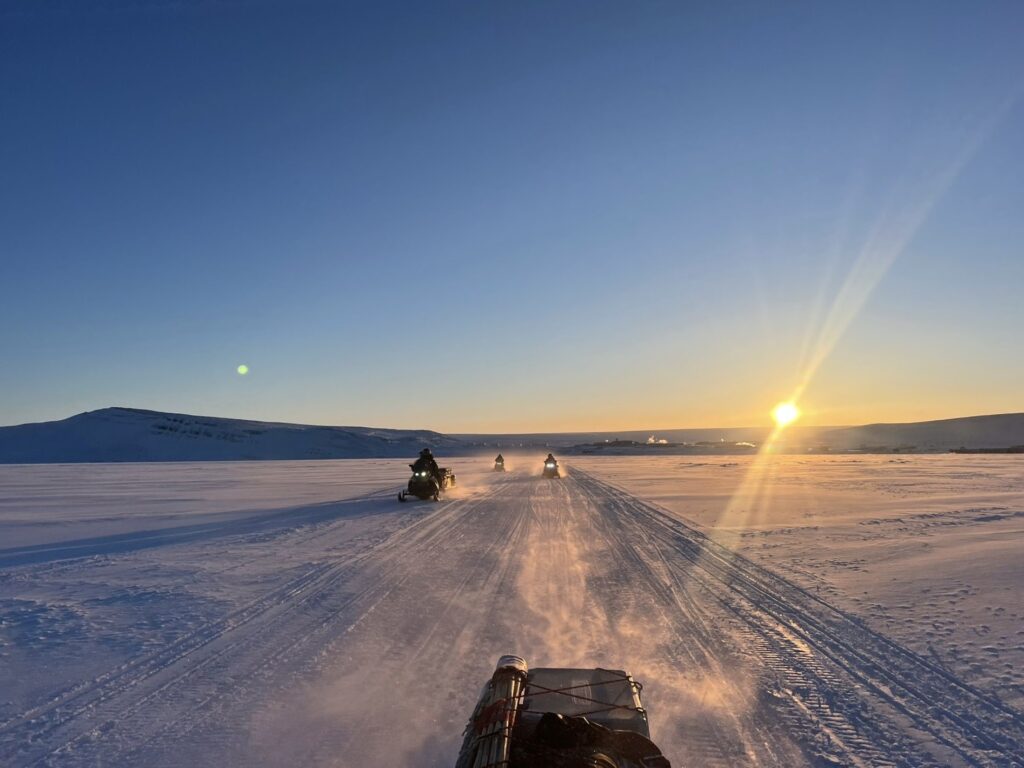
Snowmachines, fully loaded with equipment and people, drive across the sea ice in the sunrise to get to the dive site.
The first step to leaving base is to let people know that we’re leaving, and when we plan to be back. Safety first – this emergency contact is waiting for us to check back in safely when we get back, and has a procedure to follow for emergency rescue should we fail to call back in on time.
Then we set off on our snow machines for the world’s best commute. The next hour we drive over the sea ice, following our tracks and previously placed flags, taking in the wonder and surprising colors of the landscape.
1030 - Arrive at site
This timing changes depending on the site, sea ice conditions, and load on the snowmobiles, but is typically a pretty long commute – upwards of an hour. The traffic conditions are optimal, but the fifteen miles is driven carefully, not quickly.
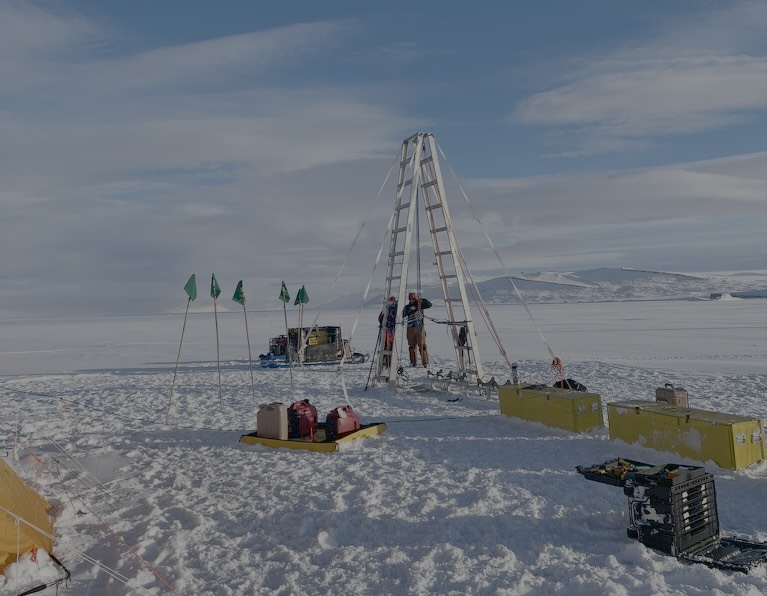
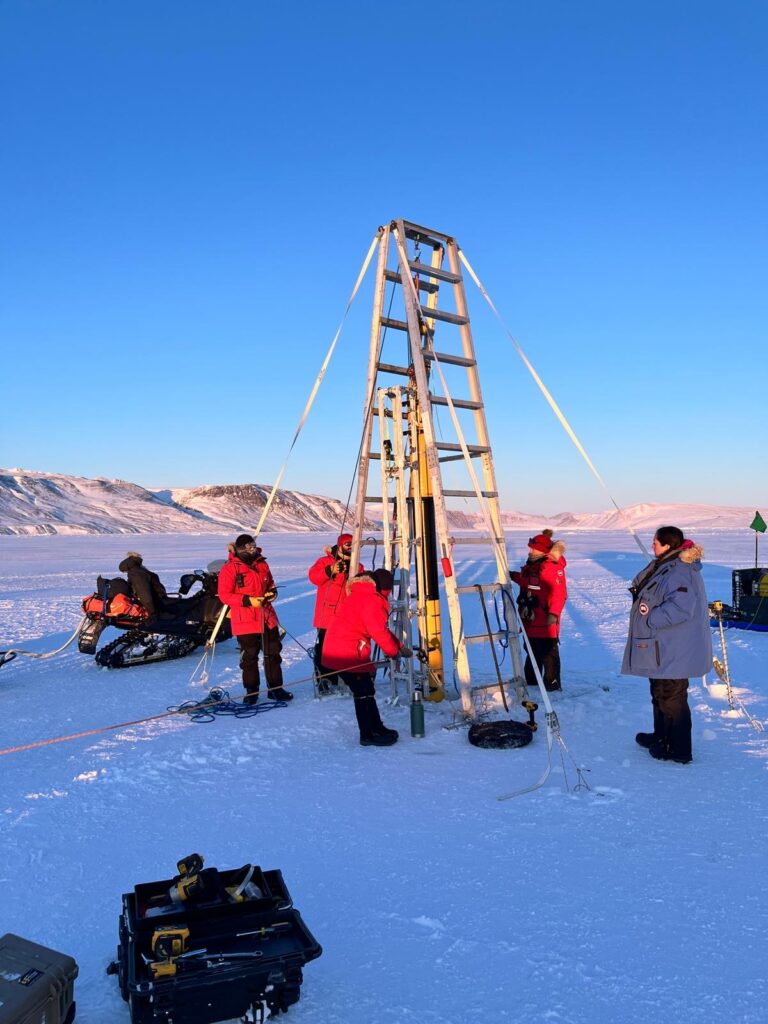
Immediately everyone jumps to work setting up tents, generators, and Icefin. Structurally sound components (like the A-frame on which Icefin is lifted and deployed) are set up ahead of time, but Icefin’s topside controls take place inside a tent that is set up and struck each dive, so site set up is a significant undertaking.
The field site in preparation - the Launch and Recovery System (LARS, or A-frame) is already set up, and the yellow boxes that contain Icefin's modules are taken off sleds.
1230 - Icefin Functional Test
Before sending Icefin into the sea, we need to check that all the sensors are performing as expected – the drive out on sleds over ice is not exactly what one would call “smooth”, so we need to ensure no connections have been broken that would preclude a dive.
Fieldwork is best lived through checklists – when you’re cold, hungry, and tired there is every chance of forgetting a critical step. We go through checklists for both the deployment setup as well as setting up the controls and command of the vehicle and testing every instrument.
1240 - Pre-dive Meeting
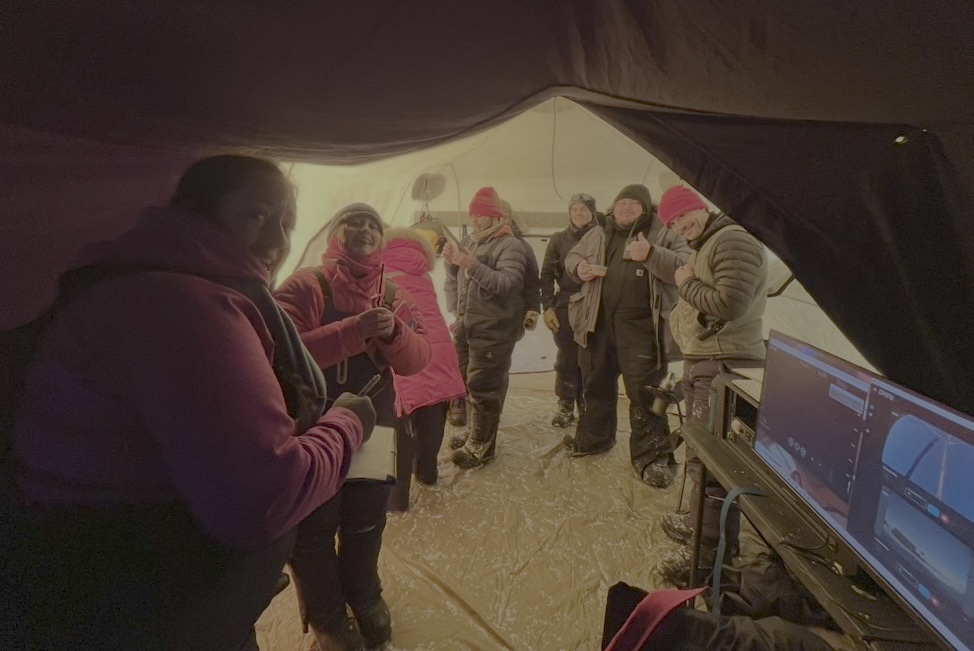
A brief break in the action occurs while everyone gathers inside the tent to review the plans for the dive, discuss roles, potential hazards, and operational notes. Everyone fills out a “dive card”, which records the location, time, dive log name, science priorities, and mission plan.
The team gathering in the tent for a quick meeting to re-establish mission goals and roles.
1250 - "Launch"
The team gathers around the Launch and Recovery System (LARS) with Icefin lifted to be vertically over the hole. Henry and Veronica are operating the lifting ropes.
All hands are needed on deck for the next operation – nearly everyone emerges from the tent to assist in lifting Icefin on the Launch and Recovery System (LARS) and send it down the borehole. Icefin is lifted using a system of ropes and pulleys, then its weight is transferred to its kevlar-reinforced fiber optic tether for deployment down the hole.
1300 - CTD cast
Every dive begins with Icefin lowered vertically to the seafloor, treating it as an extremely overpowered CTD instrument (conductivity, temperature, depth/pressure). This cast provides the first look – for the vehicle – at the entire water column’s properties, as these signals can be used to calculate salinity and density. Other sensors, of course, are also running and providing even more information throughout the entire water column, such as dissolved oxygen and turbidity. All of this can be used to identify tracers of specific water masses; for example, identifying the depth at which the plume of subglacial outflow is pouring out into the fjord.
1330 - Dive "begins"
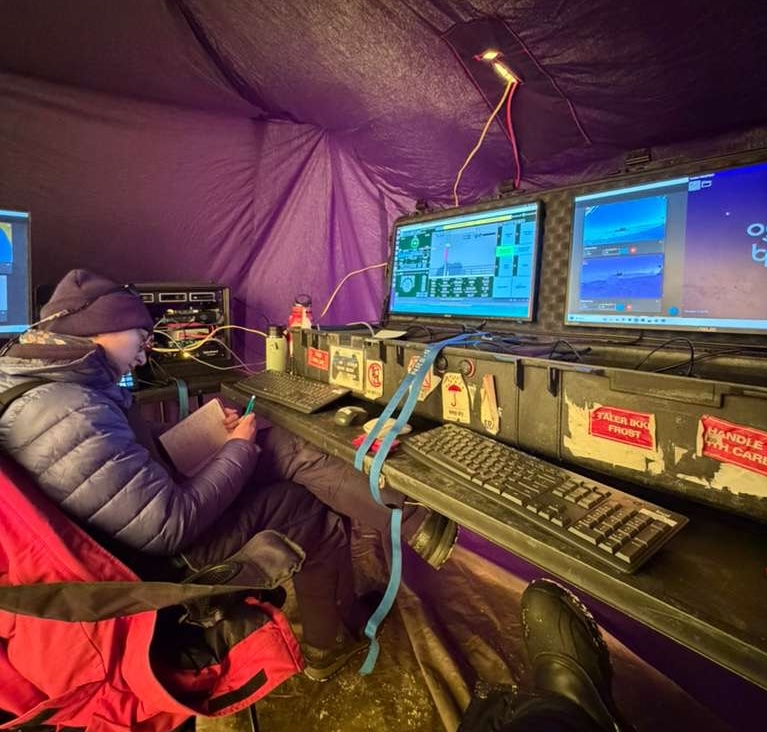
Dr. Frances Bryson taking notes in front of the topside during the dive - the screen on the left shows vehicle controls, the right shows video and sonar.
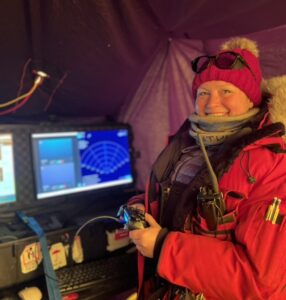
Dr. Brandi Revels excited to drive Icefin for the first time!
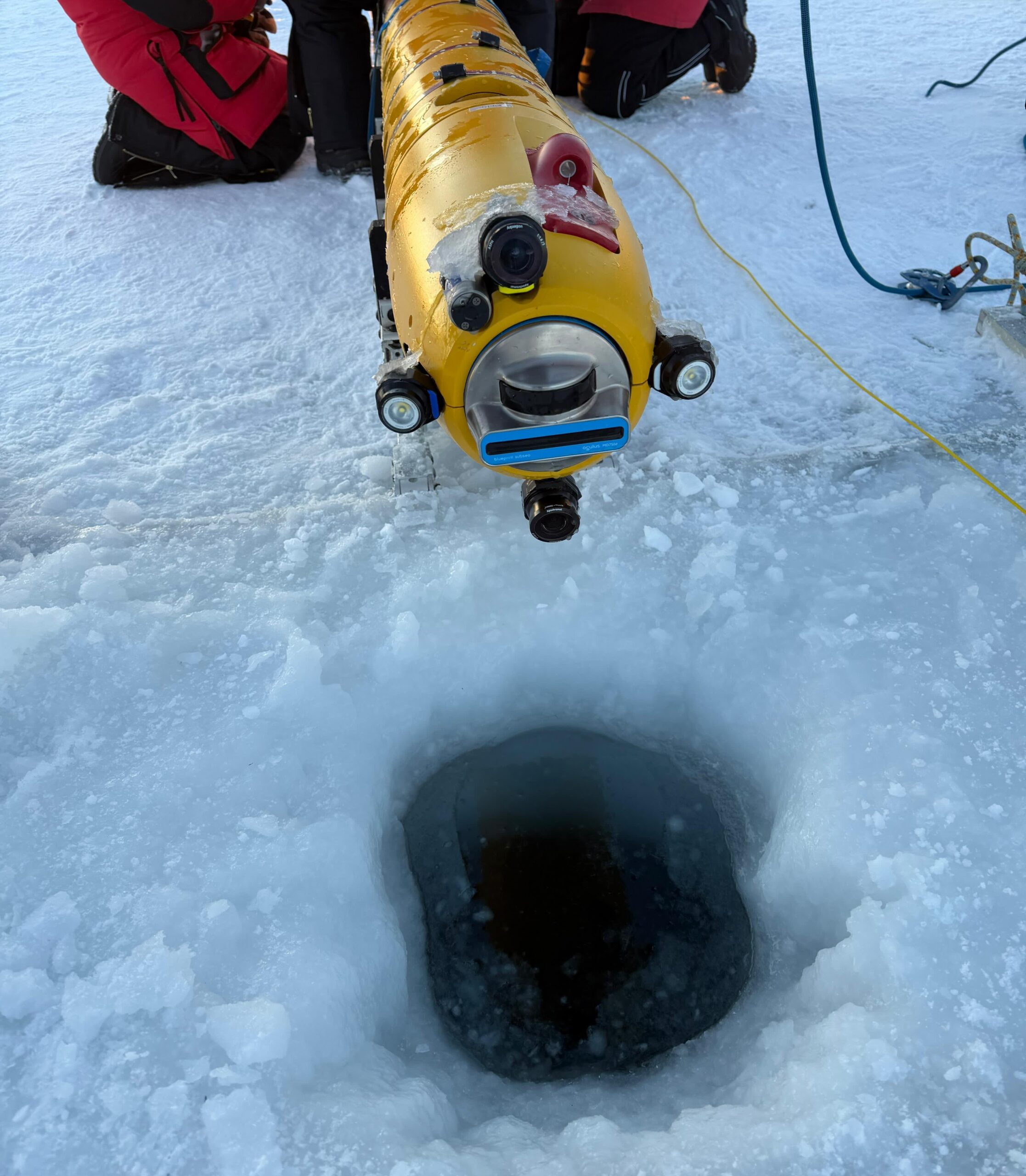
Following the CTD cast, Icefin is pulled back up to its starting depth, and the weights hanging from its front are released – using a method called “burnwires”. Icefin asserts itself horizontally, and we’re ready to start the dive for real.
Dives vary in their goals and operations, so it’s hard to generalize what this looks like, beyond a pilot driving Icefin; a co-pilot managing instrument controls and notes; a science officer managing sonar ranges, more notes, and oceanographic signals; and a hardworking outside team driving the fiber optic tether winch.
Sometimes Icefin is navigating up and down 50m of the water column as it drives out; sometimes it’s driving flat to gather bathymetry in the sonar; sometimes we’re precision-driving it into subglacial channels or around icebergs. The only constant is the exhausting state of total focus from everyone involved in their individual tasks, and the near-constant radio communication between different teams (both inside and outside the tent) checking on vehicle and tether statuses.
1800 - Vehicle recovery
Most days the vehicle has done the hard work in driving away from the hole, so we give it a break and let the winch pull it back. If all is well, the vehicle comes straight back to the hole with minimal inference between the tether and icebergs.
As Icefin’s being pulled in, the hard work of the dive is mostly behind us, so we start to pack down the site until all hands are needed again to lift it out of the hole and back onto land. Critical data is moved from computers to hard drives, and then everything is taken apart just as it was put together at the beginning of the day.
In the early season this happens a lot earlier in the day (sunset progresses from around 1600 to 2000 throughout the season), so take this and the following timestamps with a grain of salt – these are all later-season timing.
Icefin is recovered often with icicles around its nose.
2030 - Departure
Site packed down, including all tents struck and stored in a bear-proof container, socks exchanged for dry ones, toe- and hand-warmers refreshed, and a caloric snack quickly downed, we start our commute back home, hopefully before it’s too dark and cold.
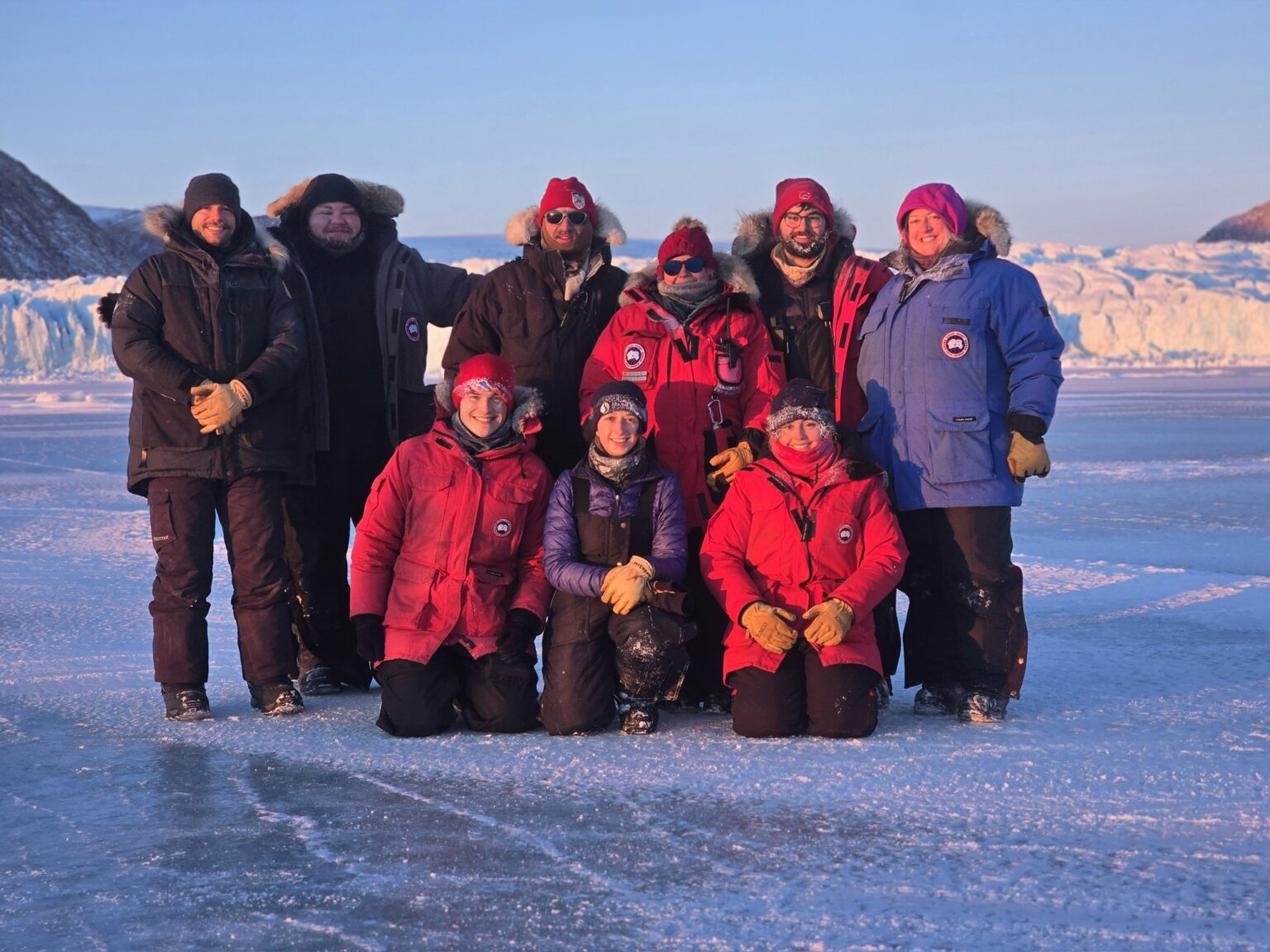
The field team (Phase 1) after a successful day of setting up site in front of Rasmussen Glacier. Top row, right to left: Dr. Peter Washam, Jorge Coppin-Massanet, Col. Paul Tanghe, Dr. Brandi Revels, Daniel Lein, Dr. Britney Schmidt. Bottom row: Henry Wolf, Dr. Frances Bryson, Veronica Hegelein.
2200 - Dinner
Finally! We’re back, have parked the snowmobiles and packed all our gear back into the dorm, so it’s time to eat some hot food (hopefully pizza) and crash. The next day will start a little later, and we’ll go through what happens on all the other days in the season in an upcoming post – dive days are only a fraction of the work and science that we do here.